








this site last updated Jul 11/08
broken link changed

PO Box 200 . Amisk, AB . T0B 0B0 (780) 856-3738 mail@nordinfarms.com |
|
About Scottish Blackface Horns
|
|
Our online store is hosted on Etsy.
Horns are available from time to time here: 
Do you baloo? fur & fiber... touchable treasure
|
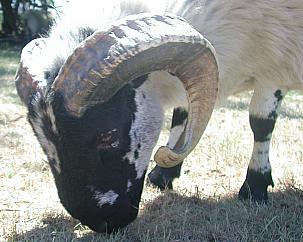
Bowick 321 (CEA 4631)
showing 16 months ram's horn growth
|
| Use of Scottish Blackface horns for carving dates back to ancient times and continues to be practiced today by such artists as Graeme MacKendrick of Balmoral, Manitoba. You can see some examples of the craft at The Shepherd’s Crook & Stick. |
| These are horns, not antlers, so they are not shed each year. |
|
Not all sheep have horns, and for many of the breeds that do, only the rams have horns.
Both Scottish Blackface ewes and rams have horns.
While both sexes have horns, the rams are typically born with horn buds whereas the ewes horns do not appear until they are a few weeks to a month old. |
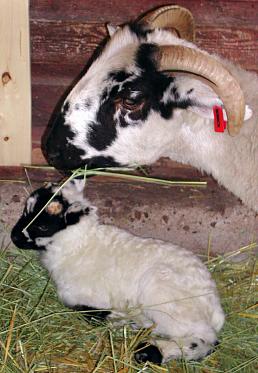
Bowick 334 (CEA 4640) and her newborn ram.
You can see his horn buds. |
| The ewes horns reach a maximum of about 12 inches long with a base diameter of about 1 1/2 to 2 inches. Ewes' horns grow in a smooth gentle arc. |
| The rams horns ressemble those of a wild mountain sheep and will continue growing throughout the animal's life. The most growth occurs during the summer months for the first 3 to 4 years. As the sheep ages, the growth rate slows. The base of a ram's horn is much larger than the female - about 2 1/2 to 3 inches in diameter. |

|
|||||||||||||||||

|